
Living Museum "Town House", "cross-perspectives on a territory"
2002
The idea of the town house is a concept that has guided my approach for a very long time, a collective tool that represents the opposite of an individual project and can be realized on a very small scale, hence the idea that, at a minimum, one could use a closet, which may have raised a smile. The aim is to create, in each municipality, city, or inter-municipal community, a dynamic around all urban issues, to provide a resource center where all documents related to urban planning would be easily accessible to elected officials, professionals, and especially the general public.
The very idea of the town house is an extension of Patrick Geddes's "Outlook Tower," both as a concept and a reality. Indeed, as early as 1892, Patrick Geddes had transformed an old tower located at the heart and summit of Edinburgh into a true laboratory for urban research and observation, open to the public. From the height of its platform, visitors could gain the experience of an "overview" of the surrounding neighborhood. The floor below was dedicated to the city of Edinburgh, and as one descended, the documentation expanded to include the region, the country, and Europe. On each floor, information was presented in a vivid form through relief maps, models, charts and graphs, and "social and industrial maps," similar in many respects to Marcel Rivière's ecomuseums.
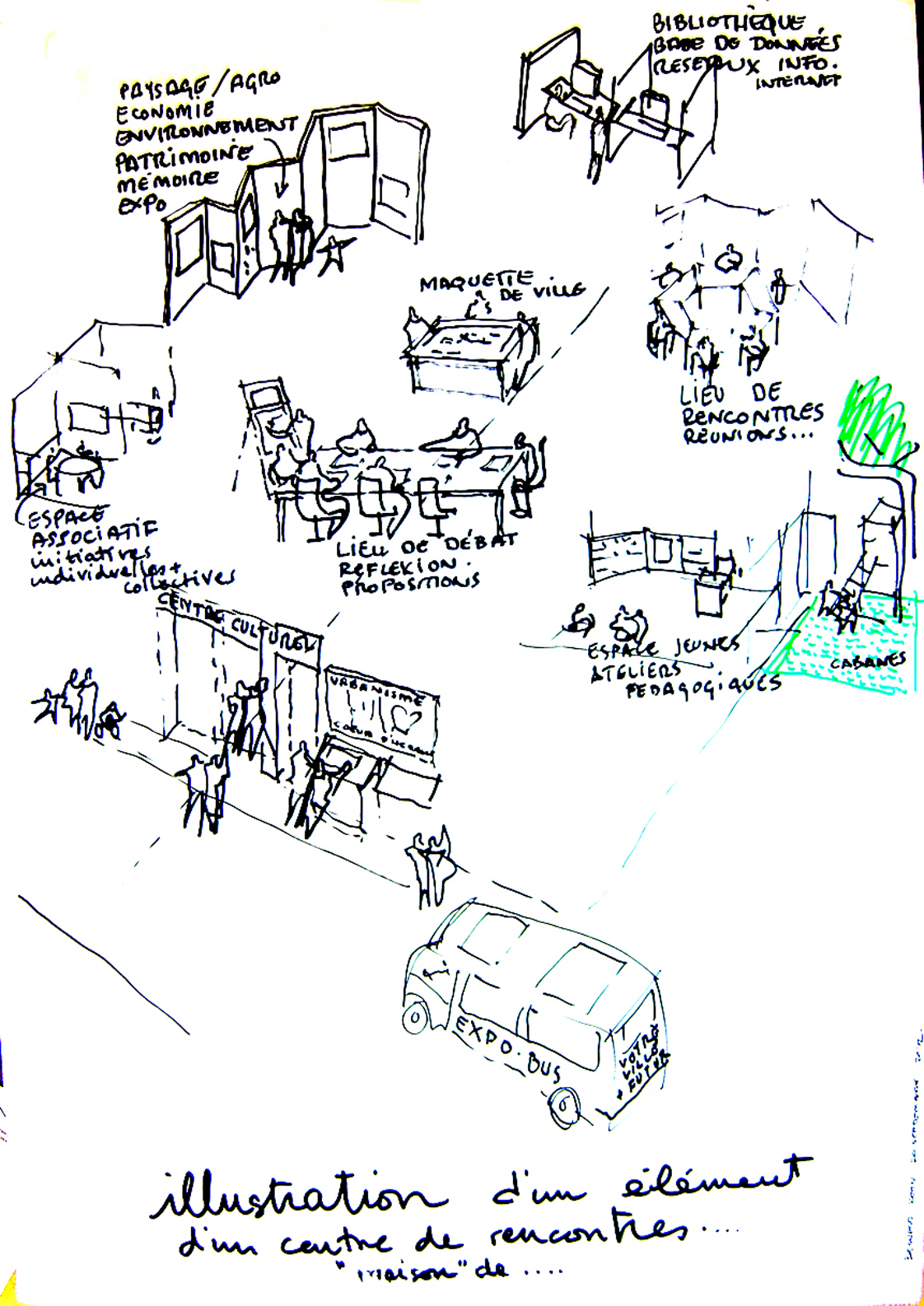
Today, this idea simply needs to be adapted to the needs of the perpetually evolving contemporary city. Each city should possess a genuine knowledge base of its origins and the various stages of its development, as it is the city's history that allows for understanding its daily reality and envisioning its future. The growing interest residents show in their environment, without necessarily having the opportunity to intervene, must also be taken into account. The complexity of urban mechanisms, the strong interaction between the global and the local, between memory and project, between conception and decision, necessitate a true space for intelligence. The town house responds to this demand: a place for information and services, for the education of all citizens, for meetings and debate, a place for cross-disciplinary approaches and knowledge bridges; it is a multi-purpose democratic tool.
One must have experienced the presentation of an architectural or urban planning project in a municipal council chamber to realize how poorly the atmosphere and organization lend themselves to genuine reflection and a true understanding of projects. Decisions are made nonetheless, without displaying land-use plans and cadastres, plans of neighboring municipalities, aerial photos and city models, old and recent studies, simulations, social, economic, and urban data... And yet these documents exist; they are simply disseminated across municipal, departmental, or regional territories, within various organizations, offices, and departments, each with its own specificity and area of intervention. Lacking analytical tools, elected officials and other participants do not have access to all the elements that would allow them to conduct a comparative evaluation and make truly informed decisions. Without, however, absolving these stakeholders of their responsibilities, it would suffice to connect all these partners through a network and a unifying space dedicated to urban issues.
The creation of such a place would have positive repercussions on the integration of schools within the city, as it is true that extending the teaching of architecture and urban planning to social demand and other disciplines is a fundamental necessity for the survival of the French educational system. The university, understood in its broadest sense, brings together all disciplines. The problems posed by the city affect all disciplines. And yet, in France, the university and the city operate in a compartmentalized manner, depending on distinct ministries. This situation is all the more aberrant given that, on the ground, everything is closely intertwined. One cannot hope to solve the major problems of our cities by referring to disciplines with impermeable boundaries. The confrontation of the educational world with social realities and demands can only be salutary and beneficial to all.
The project for a "Living City Museum," also called a "Town House" or "Resource Center," was the subject of a research mission we conducted in 2000-2001, commissioned by the Directorate of Architecture and Heritage at the Ministry of Culture. It is naturally intended to be part of urban agreements and could apply to all scales of a territorial entity: village, town, agglomeration, district. Today, new communication technologies also make it possible to combine the physical space of such a place, containing information, exhibition, and training activities, with multimedia equipment and a virtual space (an internet "portal" site listing stakeholders and activities within a territory, databases, use of GIS, geographic information systems, etc.).
The urban planning and architecture of a city should mirror its societal project, reflecting its daily life experiences and long-term aspirations. This research-action approach to urban development and town houses, whose relevance is described in the SRU Law (Solidarity and Urban Renewal), implies the use of new design methodologies and the creation of multidisciplinary teams to develop approaches that go against current practices. Nothing can come to fruition without a genuine political and social will from elected officials and the entire population.
For an Inter-municipal Urban Project
The problem of rural territories comprising twenty, or even thirty, municipalities is as concerning as that of "city" urban projects and agglomerations.
This is the case here, in the Hérault heartland:
- Inter-municipal communities have no jurisdiction over urban planning.
- Municipalities, solely responsible for their urban planning, allow for the rampant construction of housing estates, commercial zones, and disastrous city entrances... Most operate blindly and fall prey to developers, with some doubling in size every ten years. Small houses in a faux regional style proliferate, each isolated, etc.
- The department maintains (like all elected officials, for that matter) a double discourse and allows it to happen.
- The same applies to the DDE (Departmental Directorate of Equipment) and state services. The Directorate of Equipment exacerbates the situation with the construction of highways that draw even more population from large cities, thereby contributing to increased land pressure.
Faced with this rampant individualism, faced with the inertia of authorities, how can a collective component, a shared common perspective, be introduced?
La Manufacture des paysages, along with other "civil society" partners, would like to create a network, or even an informal structure, that would become a force for proposing alternative development projects in this territory—let's say, an inter-municipal urban project.
The gray and amorphous mass grows and encroaches upon this superb territory, which is rapidly deteriorating unnoticed.


